Social Context, Drinking Motives, and Alcohol Motivation

Project Overview
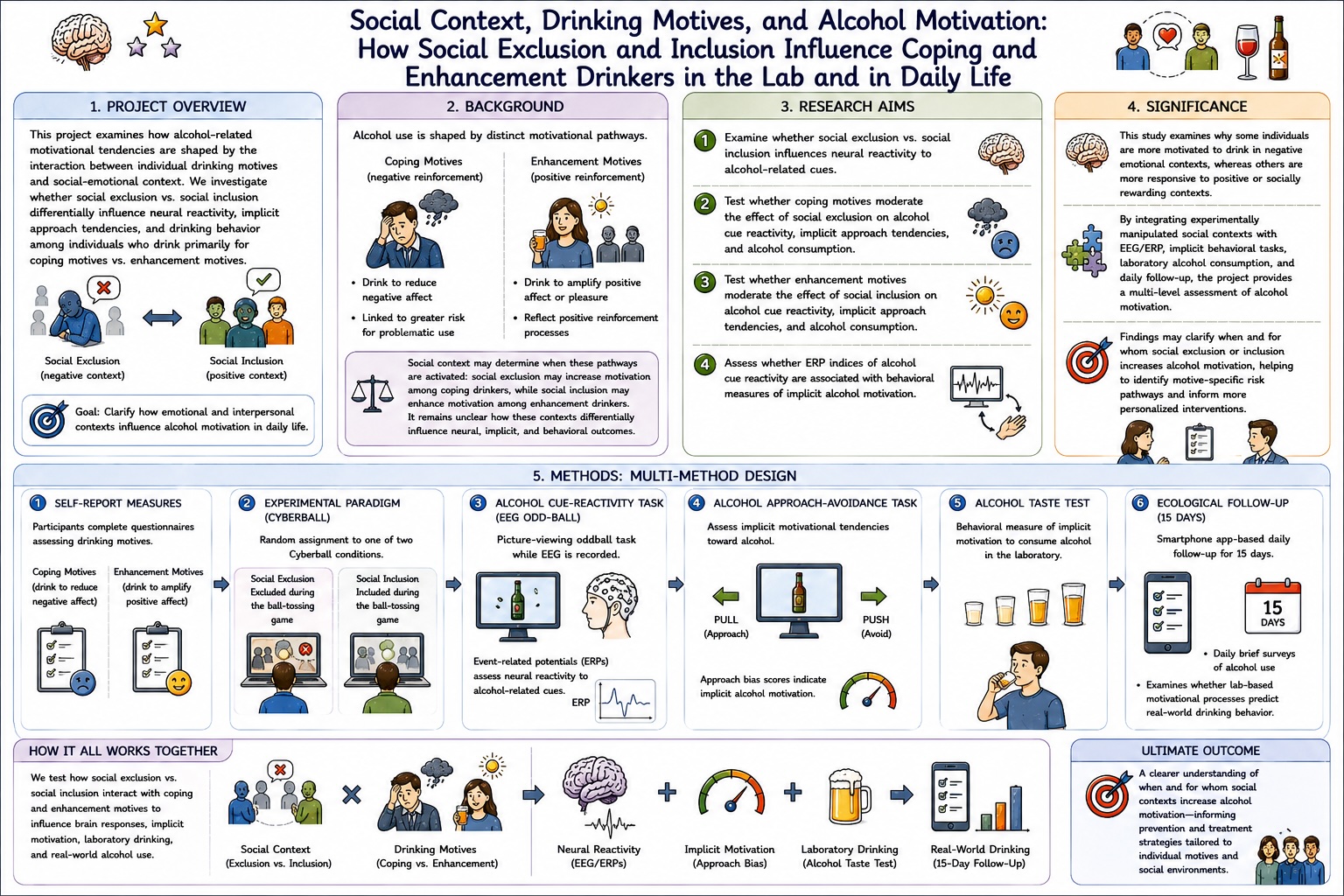
This project examines how alcohol-related motivational tendencies are shaped by the interaction between individual drinking motives and social-emotional context. Specifically, the study investigates whether experiences of social exclusion versus social inclusion differentially influence neural reactivity, implicit approach tendencies, and drinking behavior among individuals who drink primarily for coping motives versus enhancement motives. The project focuses on the distinction between alcohol use motivated by the regulation of negative affect and alcohol use motivated by the amplification of positive affect. By combining an experimental social-context manipulation, EEG/ERP measures of alcohol cue reactivity, behavioral indices of alcohol approach tendencies, a laboratory Alcohol Taste Test, and 15-day ecological follow-up, the study aims to clarify how emotional and interpersonal contexts influence alcohol motivation in daily life.
Background
Alcohol use is shaped by distinct motivational pathways, particularly coping motives, involving drinking to reduce negative affect, and enhancement motives, involving drinking to amplify positive affect or pleasure. Coping motives are linked to negative reinforcement processes and greater risk for problematic alcohol use, whereas enhancement motives reflect positive reinforcement processes. Social context may determine when these pathways are activated: social exclusion may increase alcohol motivation among coping drinkers by inducing negative affect, while social inclusion may enhance alcohol motivation among enhancement drinkers by activating positive social reward. However, it remains unclear whether these contexts differentially influence neural alcohol cue reactivity, implicit approach tendencies, and subsequent drinking behavior.
Research Aims
- Examine whether social exclusion versus social inclusion influences neural reactivity to alcohol-related cues.
- Test whether coping motives moderate the effect of social exclusion on alcohol cue reactivity, implicit alcohol approach tendencies, and alcohol consumption.
- Test whether enhancement motives moderate the effect of social inclusion on alcohol cue reactivity, implicit alcohol approach tendencies, and alcohol consumption.
- Assess whether ERP indices of alcohol cue reactivity are associated with behavioral measures of implicit alcohol motivation.
Methods
Self-Report Measures
- Participants complete questionnaires assessing drinking motives, with a focus on: (1) drinking driven by coping motives and (2) drinking driven by enhancement motives.
Experimental Paradigm
- Participants are randomly assigned to one of two Cyberball conditions: (1) social exclusion, in which participants are excluded during the computerized ball-tossing game; and (2) social inclusion, in which participants are included during the game.
Alcohol Cue-Reactivity Task
- Participants complete a picture-viewing oddball task while EEG is recorded.
- Event-related potentials are used to assess neural reactivity to alcohol-related cues.
Alcohol Approach-Avoidance Task
- Participants complete an Alcohol Approach-Avoidance Task to assess implicit motivational tendencies toward alcohol.
- Approach bias scores are used as behavioral indices of implicit alcohol motivation.
Alcohol Taste Test
- At the end of the laboratory session, participants complete an Alcohol Taste Test that provides a behavioral measure of implicit motivation to consume alcohol in the laboratory.
Ecological Follow-Up
- After the laboratory session, participants are followed for 15 days using a smartphone app.
- Participants complete brief daily surveys assessing alcohol consumption during the follow-up period.
- These data allow the study to examine whether experimentally induced motivational processes predict real-world drinking behavior.
Significance
This study examines why some individuals are more motivated to drink in negative emotional contexts, whereas others are more responsive to positive or socially rewarding contexts. By integrating experimentally manipulated social contexts with EEG/ERP measures, implicit behavioral tasks, laboratory alcohol consumption, and daily follow-up, the project provides a multi-level assessment of alcohol motivation. Findings may clarify when and for whom social exclusion or inclusion increases alcohol motivation, helping to identify motive-specific risk pathways and inform more personalized interventions.