The Role of Reward Deficits in Vulnerability to Alcohol Addiction

Project Overview
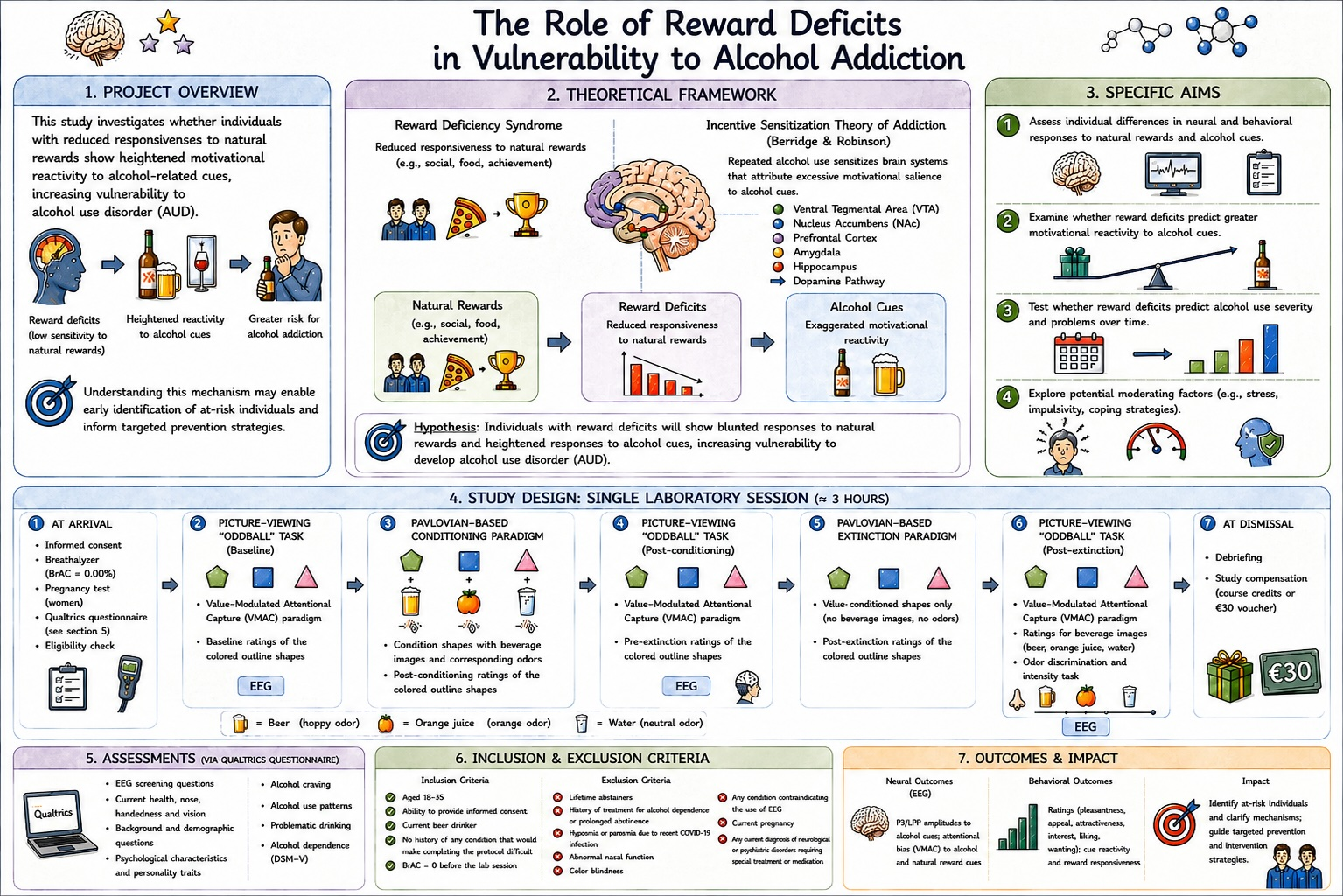
This project investigates whether individual differences in reward processing deficits contribute to vulnerability to alcohol addiction by increasing the susceptibility to develop enhanced motivational value attributed to alcohol cues. Specifically, it examines whether reduced reward sensitivity makes individuals more likely to assign incentive salience to initially neutral stimuli—such as simple geometric shapes—after these stimuli are paired with alcohol-related images and odors. By integrating Pavlovian conditioning, olfactory and visual alcohol cues, EEG/ERP indices, and attentional capture measures, the project aims to clarify how reward deficits may shape cue-driven motivational processes that increase risk for alcohol misuse.
Background
Alcohol addiction is characterized by heightened reactivity to alcohol-related cues, including exaggerated craving, attentional capture, and neural responses to alcohol-associated stimuli. Incentive Sensitization Theory of addiction proposes that repeated alcohol use can sensitize mesocorticolimbic reward circuits, causing alcohol cues to acquire excessive motivational salience. As a result, these cues may come to automatically attract attention, elicit craving, and bias behavior toward alcohol seeking.
At the same time, the Reward Deficiency hypothesis of addiction suggests that some individuals may have blunted responsiveness to natural rewards, potentially reflecting reduced tonic dopaminergic function. These reward deficits may create vulnerability to compensatory reward-seeking and may increase susceptibility to the motivational impact of alcohol cues. Within this integrated framework, reduced baseline reward sensitivity may amplify the acquisition of incentive salience when neutral cues become associated with alcohol.
Despite strong theoretical links between reward deficiency and incentive sensitization, the mechanisms connecting these processes remain insufficiently characterized in humans. This project addresses this gap by testing whether individual differences in reward deficits predict neural and behavioral responses to conditioned alcohol-paired cues.
Research Aims
- Assess whether reward processing deficits predict stronger acquisition of incentive salience to alcohol-paired conditioned cues
- Examine whether alcohol-paired geometric shapes elicit enhanced neural responses
- Test whether alcohol-paired conditioned cues produce greater attentional capture
Methods
- Participants complete a laboratory-based conditioning protocol involving initially neutral geometric shapes
- Neutral colored shapes are paired with beverage-related image–odor combinations: beer, orange juice, or water
- Pavlovian conditioning is used to establish associations between shapes and alcohol or non-alcohol cues
- EEG is recorded during a picture-viewing ‘oddball task’ to quantify neural responses to conditioned shapes
Significance
This project advances a mechanistic account of vulnerability to alcohol addiction by integrating Reward Deficiency hypothesis and Incentive Sensitization Theory of addiction. Rather than treating reward deficits and alcohol cue-reactivity as separate processes, the project tests whether reduced reward sensitivity may increase the likelihood that alcohol-associated cues acquire motivational significance. By identifying neural and behavioral markers of enhanced incentive salience attribution, the study may help clarify why some individuals are especially vulnerable to alcohol-related motivational biases. More broadly, the findings have the potential to refine etiological models of addiction by showing how blunted reward processing may interact with associative learning to promote cue-driven alcohol motivation. This could inform prevention strategies aimed at identifying individuals at elevated risk before severe alcohol-related problems emerge.