Getting Away from Your Addiction: On the Role of Attentional Disengagement

Project Overview
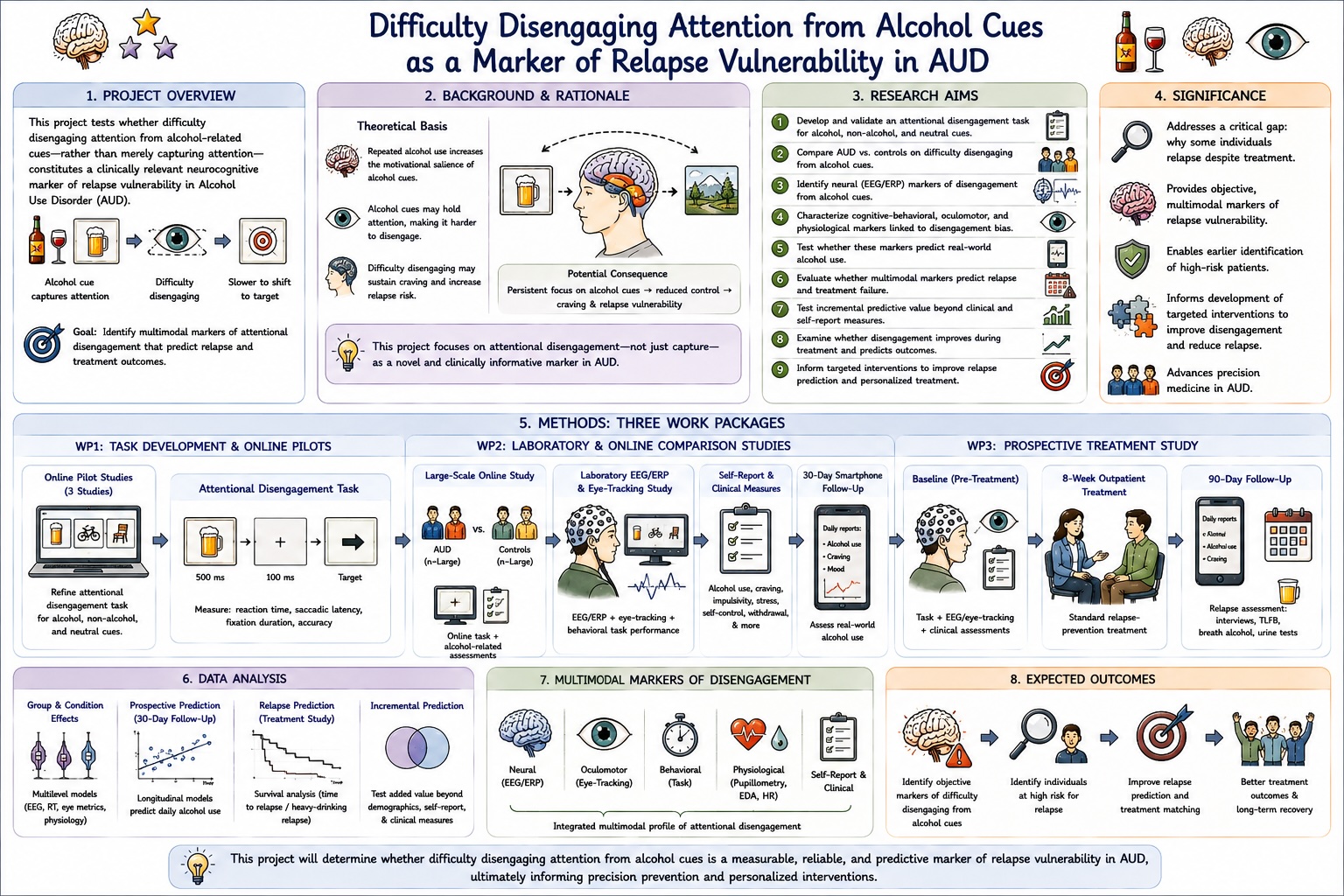
The goal of this project is to investigate attentional biases and their impact on substance abuse. The project focuses on validating a novel experimental paradigm to measure attention disengagement from substance-related stimuli, in which participants must move attention away, as quickly as possible, from a centrally presented picture that may or may not be related to their substance use. This proposal aims to validate this approach as proof of concept with individuals with alcohol use disorder (AUD) and then investigate several behavioral and neural indicators of attention disengagement as clinical prognostic indicators of relapse and treatment failure among treatment-seeking AUD patients.
Research Aims
- Develop and validate a reliable paradigm to assess attentional disengagement from alcohol-related cues
- Identify neural, behavioral, oculomotor, and psychophysiological markers of impaired disengagement from alcohol cues in AUD
- Test whether multimodal disengagement markers predict alcohol use, relapse, treatment failure, and time to relapse
- Determine whether disengagement improves during treatment and informs targeted relapse-prevention and personalized intervention
Methods
- Online pilot and large-scale assessment studies to optimize the attentional disengagement task
- Laboratory assessment combining EEG/ERP, eye-tracking, and behavioral performance measures during the disengagement task
- Prospective follow-up using smartphone reports, clinical interviews, Timeline Follow-Back, breath alcohol concentration, urine-based alcohol-use indicators, and multilevel/survival models to predict relapse outcomes
Funding
This work is financed by national funds through FCT – Fundação para a Ciência e a Tecnologia, I.P., under the project 2023.17370.ICDT.
Total funding: 250,000€
Project DOI: https://doi.org/10.54499/2023.17370.ICDT

Research Team
- Jorge Martins, PI (ISPA-Instituto Universitário)
- Jan Theeuwes, Co-PI (Vrije Universiteit Amsterdam)
- Mike Le Pelley (University of New South Wales–Sydney)
- Gün Semin (ISPA–Instituto Universitário, CRL)